


On December 24, 2025, Shigeki Kobayashi, Senior Vice Minister of Education, Culture, Sports, Science and Technology, visited Chiba University's Kashiwa-no-ha Campus and toured the Biohealth open Innovation Hub (BIH), where he was introduced to the University's latest research activities and efforts to translate science into societal benefit.
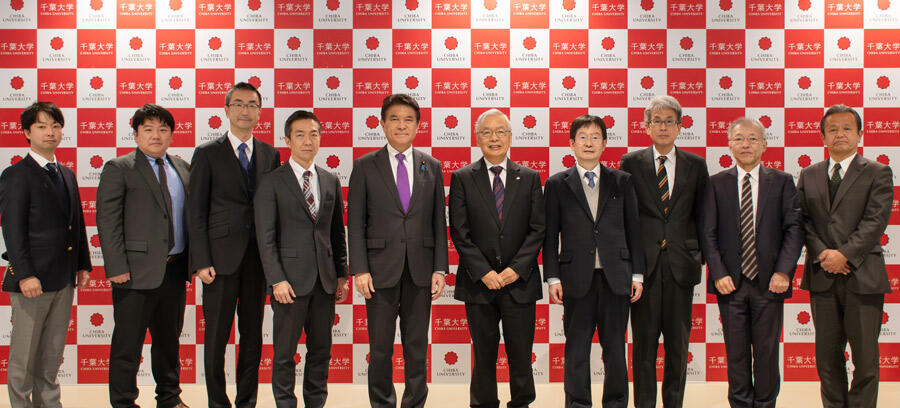
Group photo of the participants (Senior Vice Minister Kobayashi, just left of center) |
The visit opened with an overview of Chiba University's history, mission, and institutional development by Executive Director Haruaki Nakaya. Executive Director Tetsuichiro Saito then outlined the University's distinctive research profile, including work in areas such as mucosal vaccine development and environmental remote sensing, together with the institutional frameworks that support early-stage researchers, graduate students, and the long-term sustainability of research excellence.
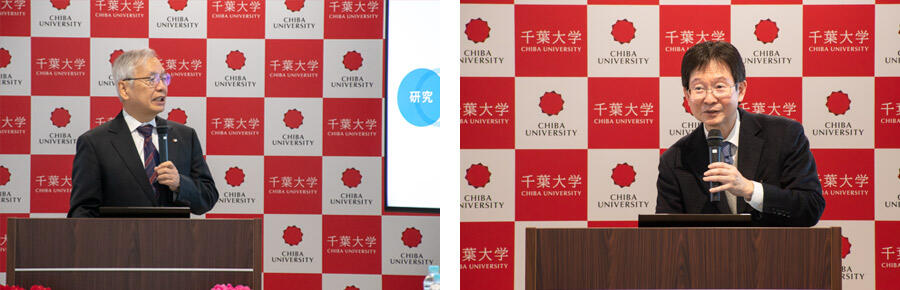
Executive Director Nakaya |
Executive Director Saito |
Vice President Hiroshi Nakajima and Special Advisor to the President Tomohisa Yamamoto subsequently presented the University's organizational reforms under the J-PEAKS initiative. These reforms aim not only to strengthen individual research fields, but also to refine institutional decision-making and governance. Through regular dialogue among the President, executive directors, and vice presidents, Chiba University is working to establish a more responsive organizational structure that supports both high-quality research and its responsible application in society.
This transformation is supported by a broad range of expertise. Alongside researchers, Chiba University is nurturing capacity in research management, industry-academia collaboration, and data science. Doctoral students and early-career researchers are also encouraged to take part in strategic planning and project management, allowing for professional development while contributing to the University's long-term direction.
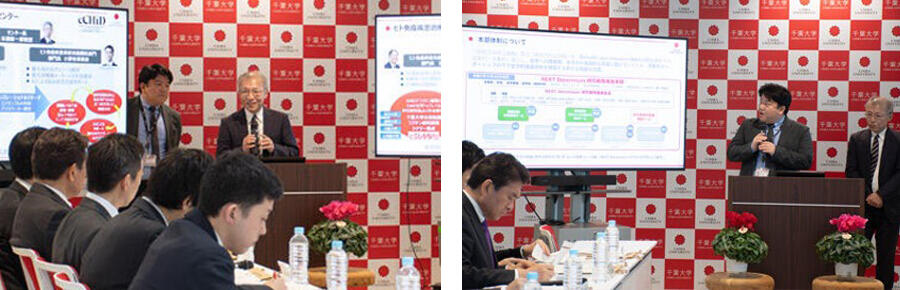
Vice President Nakajima |
Special Advisor to President Yamamoto |
During the research presentations, Professor Kiyoshi Hirahara from the Graduate School of Medicine described the social and scientific significance of recent advances in immunology, including the discovery of proteins associated with immune disorders. Associate Professor Atsushi Okazaki then introduced his work on reconstructing past climates through simulation and applying those insights to improve contemporary weather forecasting, highlighting the connection between fundamental science and its societal relevance.
Director Hitoshi Watanabe of the Center for Environment, Health and Field Sciences emphasized that the Kashiwa-no-ha Campus itself functions as an integrated research environment, enabling researchers to test and refine their findings under real-world settings. This close connection between laboratories and the field facilitates a continuous feedback loop between discovery and application.
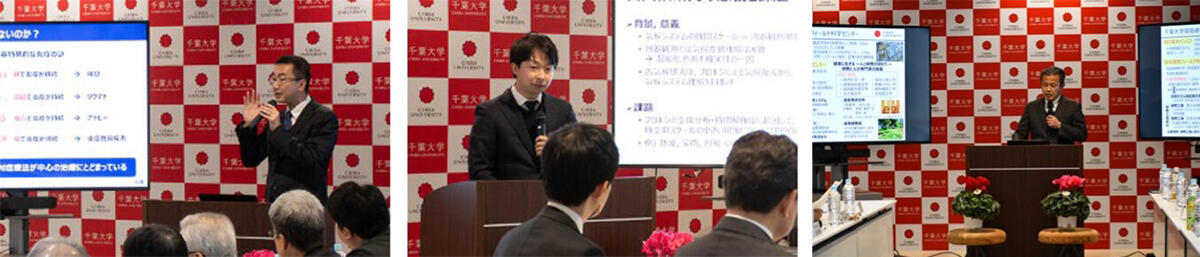
Prof. Hirahara |
Associate Prof. Okazaki |
Director Watanabe |
In the course of the facility tour, Professor Eiji Goto from the Graduate School of Horticulture showcased genetically modified rice developed for oral vaccine delivery, as well as experiments on growing lettuce in a facility designed to simulate space-like environments. These projects illustrated how sustained empirical inquiry can lead to innovations with practical and long-term significance.
The visit concluded with a demonstration of "Adam," an autonomous AI robot developed by Kisui Co., Ltd. The demonstration illustrated how academic knowledge can be translated into practical technologies through collaboration between universities and industry, contributing to innovation ecosystems that extend beyond Chiba University.
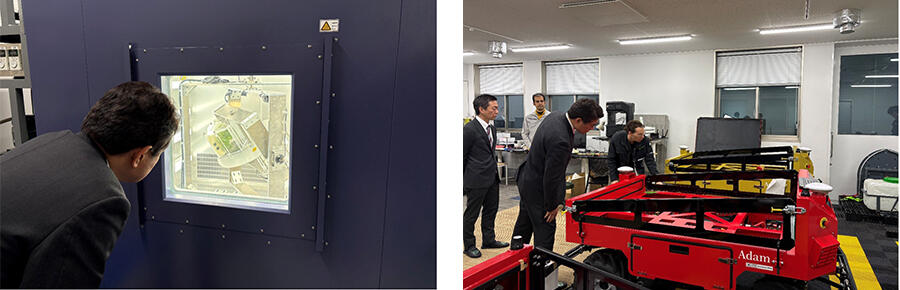
Senior Vice Minister Kobayashi viewing a low-gravity, |
Senior Vice Minister Kobayashi being briefed on "Adam" |
Many of Chiba University's research initiatives, including vaccine development, are pursued in collaboration with international partners and are oriented toward addressing global challenges such as public health and environmental change. Chiba University hopes that this visit will contribute to constructive dialogue on how national policy and institutional initiatives can work together to support research that is both scientifically rigorous and socially meaningful.
Chiba University remains committed to advancing research, strengthening partnerships with government and industry, and expanding international collaboration, thereby continuing to serve as a bridge between scientific inquiry and society.